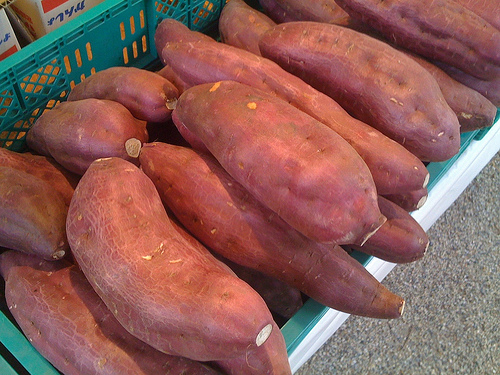
Secret no.25 Sweet potato

4242731514_9753fcb60aWhat does Jamie Oliver have in common with a 111-year-old Lessie Brown from Cleveland, Ohio? They both believe that eating sweet potatoes will help you live to 100. Jamie has fame on his side and a new cookery programme on Channel 4, promoting the health benefits of 14 ‘hero’ ingredients including the sweet potato.

But it’s Lessie who has the wisdom of experience, having been born in Georgia in 1904, over 70 years before Jamie. Georgia produces a lot of sweet potatoes (Ocilla, Georgia even hosts an annual Sweet Potato Festival) and Lessie would have gone through quite a few before she moved to Cleveland in 1922.

There she married, going on to have five children, 24 grandchildren, 44 great-grandchildren and 26 great-great-grandchildren. Her daughter, Bernie Wilson, says her mum used to love sweet potatoes and passed on the advice to others: “She even told a lot of people that would eat sweet potatoes. They thought that would give them longer lives too.”

But could it?

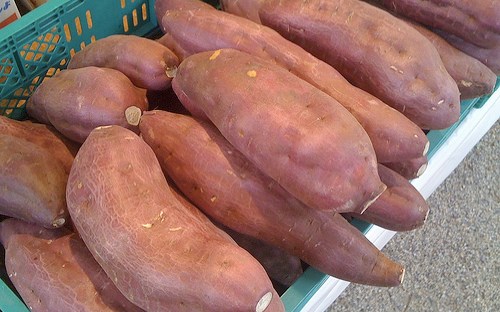
Plausibility rating: 7 out of 10. If you’re only going to eat one vegetable, you could do a lot worse than the sweet potato. Not to be confused with a yam (duels have been fought over less), a single medium-sized sweet potato has around double the recommended daily allowance of Vitamin A and is rich in Vitamin C, iron and thiamine.

Sweet potatoes are also a great source of the antioxidant beta-carotene which is associated with a range of benefits, including your immune system, protecting against free radicals, and perhaps lowering your risk of heart disease and cancer.

And it’s not just Georgia sweet potatoes that offer the benefits. Jamie’s programme focuses on the inhabitants of the Okinawa islands in Japan, who eat a purple-fleshed variety of the sweet potato as a staple part of their diet. Okinawans famously live a very long, very healthy life. And a well documented one: since 1975, the Okinawa Centenarian Study has recorded how its centenarians ‘age slowly’, delaying or sometimes even escaping the chronic diseases of aging including dementia, cardiovascular disease (coronary heart disease and stroke) and cancer.

Overall, this is about as credible as evidence gets (Jamie would perhaps call it ‘pukka’). It is not, of course, all down to sweet potatoes. The study suggests that genes combine with  lifestyle factors to produce the remarkable longevity of the Okinawans. One of the those lifestyle factors is how much you eat, which we considered briefly here, but what you eat is also critical, and high fruit and vegetable consumption is key.

So Lessie would probably have been giving good advice when she told her neighbours to eat sweet potato.

NEWS: Take the ‘Living to 100’ test

Truthfully, no one can tell you whether you’ll live to 100 – but lots of people are willing to take a guess. This ‘Living to 100 Expectancy Calculator‘ is more sophisticated than most, requiring you to answer 40 quick questions about your diet, lifestyle, current health and family background. It’s got some decent science behind it too, having been created by Dr Thomas Perls, the director of the New England Centenarian Study – the largest study of centenarians and their families in the world.

Does it perhaps err on the positive side? When I completed it recently I was told I would live to 92, which is higher than most other similar tests I’ve completed. But, hey, I’m not arguing.

If you want a slightly different take on living to 100, this simple tool from the Office of National Statistics will give you a probability of you reaching the magic age.


NEWS: Forty UK centenarians celebrate birthdays every day

There are some remarkable statistics in the latest Office of National Statistics report on the very old in the UK. But the most eye-catching is the fact that in 2014 there were 14,450 centenarians, a huge rise from the estimated 3,250 just 30 years ago. It means that, on average, 40 centenarians are celebrating their birthdays every single day of the year. Even more remarkably, by 2037 there are expected to be 111,000 centenarians in the UK, meaning that on any given day you could expect over 300 to be celebrating their birthdays.

However if you want to attend a centenarian birthday party today you should go to Japan, which already has around 59,000 people aged 100 and over. That means that on a typical day there will be 163 centenarians celebrating. That number- which is rising by around 5,000 every year – has recently begun to worry a penny-pinching Japanese government. It has traditionally given each centenarian a silver sake cup, or sakazuki, when they hit 100, at an annual cost of £1.3m. The planned response? To make the sakazuki from a cheaper metal.

In the UK there’s no gift but a somewhat cheaper tradition of sending congratulations to centenarians which began in 1908 when Edward VII had a message sent to the Reverend Thomas Lord of Horncastle. It read:

‘I am commanded by the King to congratulate you on the attainment of your hundredth year, after a most useful life.’

But it was not until 1917 and the arrival of King George that it became routine to send messages of congratulations to people celebrating important anniversaries. Today, centenarians receive one on their 100th birthday, 105th birthday and every year after that. For many years, the message was sent in the form of a telegram but is now sent as a card. The tradition has not been left untouched by rising numbers of centenarians though – in 2014 the team organising the cards was expanded to seven to cope with the increasing number of recipients.

My favourite celebration however comes from Australia. Since 1993 Australians hitting 100 have been eligible to join the rather wonderful 100+ Club, which says it ‘aims to bring centenarians together at different events so that they may talk to someone their own age and share their memories and stories!’ It is very much an elite organisation – the only way you can join is to reach 100 – and it even has its own Facebook page.

And the club’s motto? ‘Just Keep Breathing’.

photo credit: Happy Birthday Cake! via photopin (license)

NEWS: That’s another Guinness for me…

3820217887_a430856208_mAnother centenarian has sworn by a daily pint of Guinness. According to her local newspaper, Alice Patten takes no medication – just a glass of the black stuff every day, apparently on the advice of her doctor. Alice has just turned 100 and still gets out and about shopping. ‘She still has all her marbles and is 100 per cent with it,’ says daughter Brenda, who lives with her.

We’ve previously seen how fellow centenarian Gladys Fielden says Guinness is her longevity secret, though sadly we could only give it a disappointing 5 out of 10 as a potential route to a longer life.

NEWS: your odds of reaching 100

11423356086_6ee79a969b_oThe Office for National Statistics has come up with a simple tool that calculates your chances of living until the age of 100 – at which age you’ll be eligible not only for a letter from the ruling monarch but also to pass on your longevity secret to your local newspaper. The tool is here. If you want a benchmark, I apparently have an 11.4% chance of hitting the magic age.

NEWS: 113-year-old San Francisco earthquake survivor dies. Her longevity ‘secret’ was a Scotch and water every night.

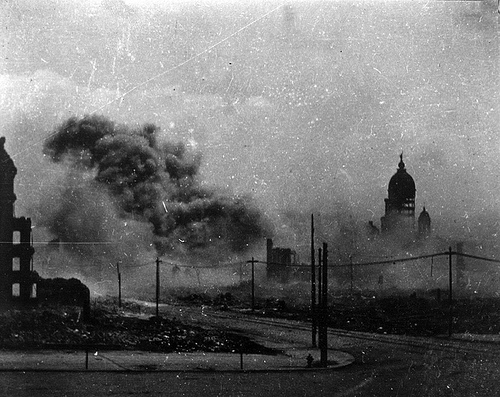
5572751884_7f2877d098Ruth Newman, who died earlier this month, was just four when the San Francisco earthquake struck in 1906, leaving over 3,000 people dead.

Her daughter Beverley Dodds, herself now 85, says her mother remembers her father picking her up and running out of the house. ‘She would tell us she remembered my grandmother being upset because they had just milked the cow earlier… and put it in containers that got thrown to the floor’.

The family was living on a ranch 70 miles north of the city and their home was undamaged but many others were not so lucky: half the city’s 400,000 residents were left homeless. The quake lasted less than a minute but ignited fires around the city that burned for three days,

With Ruth Newman’s death there is now just one known survivor of the earthquake still alive, William Del Monte, who was three month’s old at the time.

Having survived the quake, what was the secret for Ruth’s long life? Daughter Beverley told the Daily Mail that it may have been down to good genes and a glass of scotch and water every night before bed. We’ve seen that alcohol is fairly often cited as a cause of longevity and while there’s some evidence for the belief it remains controversial. We’ll address genes in a future blog but there’s little doubt they are critical to longevity and Ruth’s family is strong evidence for that – her older brother Barney lived to 108 and their younger sister Genevieve to 103.

But there are also other possible contributory factors. Ruth stayed active knitting, baking and gardening, and continued to drive and play golf until her mid-90s. In a future blog, we’ll look at whether ‘a good walk spoiled’, as Mark Twain famously called golf, could help you live longer.

photo credit: San Francisco earthquake and fire, 1906 via photopin (license)

NEWS: Is alcohol really such an aid to longer life?

3208521661_587da1bcd9_oMany of our centenarians have thought that a drop or two of whisky, sherry or Guinness have played a part in helping them reach 100. And we’ve seen that there’s apparently a lot of research evidence to support them – moderate drinking has been associated with longer life in several studies.

However, as this BBC article reports, new research raises questions about those studies. Often they have included as ‘non-drinkers’ people who have had to give up alcohol for health reasons. It’s not hard to imagine that this might skew the data and, sure enough, when they’re taken out the health benefits of alcohol disappear almost entirely. Plus, as the article points out, there are 200 diseases and injuries that are linked with alcohol, including 30 that are caused only by alcohol.

So our initial, cautious 5 out of 10 plausibility rating may even be a little too generous.

photo credit: Beers and Cheers 011809 via photopin (license)

STORY SO FAR: top-rated ways to live to 100

Twenty entries in to our ‘101 ways to live to 100′ and already one or two trends are emerging. Alcohol and religion both turn up in quite a few of our centenarians’ secrets to longevity, as does chocolate. So far, no one has mentioned genetics (though a few have mentioned ‘family’). And our surprise leader is mountaineering.

Our league table below is surely the only time these words have ever appeared in a list together:

9/10: Mountaineering
8/10: A loving family; Be happy and enjoy life;
7/10: A good doctor; praising God
6/10: One meal a day; sleep; hard work
5/10: ChocolateMonogamy; Guinness; Yoga; a lot of booze
4/10: Two raw eggs;
3/10: Work less overtime;
2/10: Bacon
1/10: Water from a wishing well
0/10: Pearls
No score: Good food; stem cells

Back soon with: Does a sense of humour help you live longer?

Secret no.20 Chocolate

Blogger Penny Walford recently wrote a touching piece about her great aunt Marie, who had died aged 106. Marie sounds a remarkable woman, who travelled the world in her youth by hitching rides on cargo ships. Penny first met her later in life, when she would follow her favourite ice hockey team, the Ottowa Senators on TV and, when her eyesight failed, on the radio.

Penny describes how Marie was a strong and active woman who swam every day when she was younger and walked every day as she got older. Even at 106 she was still taking a turn around her nursing home. So surely this explains her long life?

663196031_86e3acb4f4

Well not according to Marie. She and Penny had a shared love – chocolate. And it is to this that Marie gave credit for her long life. Penny describes how Marie ate it every day, with half-hidden stashes of it near her bed and usually a couple of bar wrappers in or around the wastepaper bin. (In the interests of accuracy, I should also say that Penny thinks Marie’s love of chatting and storytelling also helped her live longer and we’ll return to this theme in a later post).

So is this possible? Could Cadbury and Hershey be manufacturing the key to a longer life?

Plausibility rating: 5 out of 10. While at first the idea of chocolate as a superfood seems outlandish, it turns out Marie is not the only centenarian to give it credence. Bernard LaPallo is 110 and he too says, chocolate (along with four other ‘superfoods’) is the reason while 105-year-old Edna Sandys also thought it had played a part. And perhaps we were wrong to focus on the two raw eggs that Emma Morano eats (No. 12 of our 101 ways) and should instead have followed the evidence of the chocolate that goes missing in the night.

So what about the science part? Well, there is some reported evidence to support chocolate’s credentials. It is high in polyphenols, which may protect against heart disease (along with lots of other, healthier-sounding, foods like blueberries, cereal bran and green tea). It may also help lower blood pressure and some studies suggest a reduction in heart attack, stroke and diabetes. Certainly the internet is full of articles with titles like ‘the 9 health benefits of chocolate’ and ‘7 reasons why chocolate is healthy’.

However, on closer examination the benefits of chocolate do tend to dissolve, a little like cocoa powder in hot milk. Many of the studies are small and still need confirmation. And they tend to focus on either cocoa or strong dark chocolate, not the mass-produced stuff that most of us eat and which is made up mainly of milk fat and sugar. Alison Hornby of the British Dietetic Association brings us down to earth: “Chocolate is an energy-dense food that could contribute to weight gain and a higher risk of disease. As an occasional treat, chocolate can be part of a healthy diet. Eaten too frequently, it is an unhealthy choice.”

I fear this is good, sensible advice  – even if Marie, Bernard, Edna and Emma were all able to ignore it and still make their way to 100. Kit Kat, anyone?

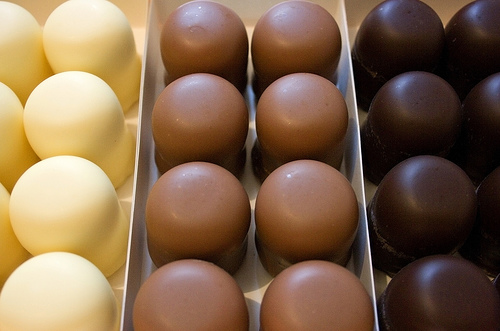
photo credit: Geknöppel via photopin (license)

Secret no.19 Mountain walking

Centenarian Nellie Sillitoe celebrated her 70th birthday by climbing Mount Snowdon in Wales. Nellie and her husband Reginald were keen mountaineers and climbed peaks in Austria, Italy and Switzerland – a pastime that son Richard, now 71 himself, gives credit for Nellie’s longevity.

18163636_2fc37dc769“My parents were great mountain walkers,” he told the local Stoke Sentinel. We were brought up in that environment, being taught to love the outdoors. I think that all those years of mountaineering were very beneficial. (It may also have had some impact on Richard’s choice of career – he is a professor of geology).

Richard’s account suggests other factors may also have played some part in his mother’s long life: “She has always maintained her mobility and made sure to get lots of fresh air and ate a fairly scrupulous diet. Her most exceptional trait, echoed by a number of people, is that she’s never been known to say a bad word about anyone. She always sees the best in people.” And perhaps in situations. Asked what she thought of her 100th birthday, Nellie said: “It’s just like any other day. You have to make the best of this world.”

But sticking with mountaineering for a moment, is it credible that it could have played a significant role in Nellie’s longevity?

Plausibilty rating: 9 out 10. At first glance, it seems unlikely that mountaineering would improve longevity. It is not without its risks, which the US National Centre for Health Statistics helpfully catalogues each year: So we know that if you choose to climb above 6,000m in the Himalayas then your annual risk of death is around 11 in 100. Even routine mountain climbing puts you at the not insubstantial risk of death of 1 in 1,750. However – though the Stoke Sentinel is not clear on this point – it seems more likely that Nellie and her husband in fact took part in what the NCHS categorises as ‘mountain hiking’. Fortunately for this the chance of death, er, plummets to 1 in 15,700. That still makes it more than twice as risky as scuba diving but it’s certainly not base jumping (1 in 60) or grand prix racing (1 in 100).

So if the risks of mountaineering/mountain walking aren’t such an issue, what about the benefits? These, in turns out, are substantial. The British Mountaineering Council says that regular brisk walking will ‘improve performance of the heart, lungs and circulation, as well as lower blood pressure‘, while regular walking ‘has been shown to reduce the risk of chronic illnesses, such as heart disease, type 2 diabetes, asthma, stroke and some cancers’. And don’t get them started on the mental health benefits: walking ‘heals our brains, helps us concentrate, makes us more creative and can help treat depression’. But does it add years to life? Plenty of studies suggest it does. One, in 2012, found that regular, moderate physical exercise such as brisk walking could increase life expectancy by several years. Normal weight people who exercised for at least 150 minutes a week lived over 7 years longer than people who were inactive or obese.

So there we have it. Mountain hiking really could be responsible for some of Nellie’s longevity. It alone may not have got her all the way to 100 but it could well have helped.

photo credit: Mt. Goryu via photopin (license)