
Secret no.25 Sweet potato

4242731514_9753fcb60aWhat does Jamie Oliver have in common with a 111-year-old Lessie Brown from Cleveland, Ohio? They both believe that eating sweet potatoes will help you live to 100. Jamie has fame on his side and a new cookery programme on Channel 4, promoting the health benefits of 14 ‘hero’ ingredients including the sweet potato.

But it’s Lessie who has the wisdom of experience, having been born in Georgia in 1904, over 70 years before Jamie. Georgia produces a lot of sweet potatoes (Ocilla, Georgia even hosts an annual Sweet Potato Festival) and Lessie would have gone through quite a few before she moved to Cleveland in 1922.

There she married, going on to have five children, 24 grandchildren, 44 great-grandchildren and 26 great-great-grandchildren. Her daughter, Bernie Wilson, says her mum used to love sweet potatoes and passed on the advice to others: “She even told a lot of people that would eat sweet potatoes. They thought that would give them longer lives too.”

But could it?

Plausibility rating: 7 out of 10. If you’re only going to eat one vegetable, you could do a lot worse than the sweet potato. Not to be confused with a yam (duels have been fought over less), a single medium-sized sweet potato has around double the recommended daily allowance of Vitamin A and is rich in Vitamin C, iron and thiamine.

Sweet potatoes are also a great source of the antioxidant beta-carotene which is associated with a range of benefits, including your immune system, protecting against free radicals, and perhaps lowering your risk of heart disease and cancer.

And it’s not just Georgia sweet potatoes that offer the benefits. Jamie’s programme focuses on the inhabitants of the Okinawa islands in Japan, who eat a purple-fleshed variety of the sweet potato as a staple part of their diet. Okinawans famously live a very long, very healthy life. And a well documented one: since 1975, the Okinawa Centenarian Study has recorded how its centenarians ‘age slowly’, delaying or sometimes even escaping the chronic diseases of aging including dementia, cardiovascular disease (coronary heart disease and stroke) and cancer.

Overall, this is about as credible as evidence gets (Jamie would perhaps call it ‘pukka’). It is not, of course, all down to sweet potatoes. The study suggests that genes combine with  lifestyle factors to produce the remarkable longevity of the Okinawans. One of the those lifestyle factors is how much you eat, which we considered briefly here, but what you eat is also critical, and high fruit and vegetable consumption is key.

So Lessie would probably have been giving good advice when she told her neighbours to eat sweet potato.

Secret no.24 Whisky

9932066903_a466fa3984What is it with whisky? Lots of our centenarians have thought that a shot or two of Scotch was the reason they’ve made it to 100.
Recently we recorded the death of Ruth Newman, one of the last survivors of the 1903 San Francisco earthquake, who said that her longevity secret was a Scotch and water every night. We’ve also recorded the death at 111 of Nazar Singh, who cited good food, a loving family – and again a tot of whisky every night. And Agnes Fenton upped the alcohol stakes a little by saying her secret was three beers and a whisky chaser.

The most recent advocate is 109 year old Worcestershire woman Grace Jones*, who turned 109 this month (September) and has had a small glass of whisky every night for the last 57 years. Grace has lived through the reigns of five British monarchs, starting with Queen Victoria’s heir, Edward VII, and 22 British Prime Ministers, beginning with Henry Campbell-Bannerman. She’s led a bit of a nomadic life, moving house 27 times with her husband, Leonard but ‘Amazing Grace’, as she is known to her friends, is certainly consistent about her whisky – she told her local newspaper last year, on her 108th birthday: “I never miss it. I don’t drink and all I have is the whisky at night. Whisky is very good for you. He (her doctor) said keep up with the whisky Grace, it’s good for your heart.”

So is it? Or does whisky have some other quality that could possibly have helped Grace and some many other centenarians clock up their 100 years?

*Oddly, Grace is not the first Englishwoman called Grace Jones to hit 100. The ‘other’ Grace Jones lived in south-east London and, until her death in 2013 at the age of 113, was the last British person alive to be born in the 19th century.

Plausibility rating: 6 out of 10. We’ve explored other types of alcohol before and come to the conclusion that the case for it isn’t that strong. True, there is research evidence that a small amount of alcohol consumption is associated with longer life. However that evidence is disputed and once we go beyond a moderate intake, alcohol is associated with a whole lot of harm.

So why would a ‘wee dram’ be any better? Some people do use it as a nighttime sedative – the classic nightcap – so could that somehow help improve longevity? Sadly no. Alcohol may help you get off to sleep but the quality of that sleep is likely to be poorer. It does seem possible that whisky in the form of a hot toddy might help you with the symptoms of the common cold but surely that’s not enough to extend a lifespan.

However there are one or two qualities of whisky that might just put it above your average alcoholic drink and which perhaps justify our plausibility rating. For one thing, it’s relatively low in calories – about 75 in a small measure – about the same as a glass of dry white wine.  More importantly though it’s full of ellagic acid, gallic acid and lyoniresinol – all of which improve the antioxidant properties of your blood (wonderfully, the older the Scotch, the bigger the effect).  It even seems to work in practice – an admittedly small (in truth, tiny) piece of research involving the comparison of red wine, mature Scotch and a younger spirit found the Scotch had the greatest antioxidant effect. The research concludes that the findings are compatible with suggestions that moderate intake ‘decreases the risk of coronary heart disease’.

Which was exactly what Grace’s doctor said, wasn’t it? So we’re giving Grace (and her doctor), Ruth, Nazar, Agnes and Henry the benefit of the doubt and giving whisky a creditable six out of 10 as a longevity secret. Just remember to choose the very best, longest matured, single malt Scotch if you really want to live a long time.

photo credit: Various Whiskies via photopin (license)

NEWS: That’s another Guinness for me…

3820217887_a430856208_mAnother centenarian has sworn by a daily pint of Guinness. According to her local newspaper, Alice Patten takes no medication – just a glass of the black stuff every day, apparently on the advice of her doctor. Alice has just turned 100 and still gets out and about shopping. ‘She still has all her marbles and is 100 per cent with it,’ says daughter Brenda, who lives with her.

We’ve previously seen how fellow centenarian Gladys Fielden says Guinness is her longevity secret, though sadly we could only give it a disappointing 5 out of 10 as a potential route to a longer life.

Secret no.21 Sense of humour

5238022900_6b565e3cf3Is laughter the best medicine? You might have thought it would be penicillin but New Zealander Geoffrey Farrow disagrees and, after all, he’s the one who’s made it to 100.

On his 100th birthday, Geoffrey told his local paper that a sense of humour ‘is always better than a packet of pills’.  A wry sense of humour stands out strongly in his interview as Geoffrey recalls that though his family was poor his father was a chauffeur ‘so I went to my christening in a Rolls Royce’. He also has a unique take on ageing, arguing that since his step-children, grandchildren and great-grandchildren all call him ‘Pop’, he’s not getting any older.

Like many of the centenarians we’ve seen, Geoffrey has had a far-from-easy life, coping with poverty and the death of his father and a brother during his childhood. So when he says that a sense of humour has been important to him, we should probably listen. But is there any scientific support for that view?

Plausibility rating: 6 out of 10. Many people do believe that laughter is good for health. The scientific study of laughter has a name – gelotology, from the Greek root gelos, to laugh (though despite being coined in 1964, the term hasn’t made it into the OED yet). There is an Association for Applied and Therapeutic Humor, which it defines as ‘any intervention that promotes health and wellness by stimulating a playful discovery, expression or appreciation of the absurdity or incongruity of life’s situations.’ If you want, you can join the Laughter Online University or train in laughter yoga through the Laughter Wellness Institute. And for a time there was even a Journal of Nursing Jocularity, from which we have a complete categorisation of 15 types of laughter, beginning with ‘smirk’, taking in ‘snicker’, ‘chortle’ and ‘guffaw’ before finishing – alarmingly for our purposes – with ‘die laughing’ (don’t worry though: the grandfather of therapeutic humour, William Fry, tells us that heat attacks during fits of laughter are so rare there is no medical literature on mirth-provoked heart attacks’).

But where’s the scientific evidence for all this? There’s little doubt that laughing does bring about physiological and psychological changes – one academic, Ronald Berk, lists 15 of them, from reduction of anxiety to increased production of endorphins.  And there’s some research suggesting health benefits. One study of US women in their 60s and 70s found that those who watched a funny video had lower levels of stress and better short-term memory. So could that lead to longer life? Possibly. A study by researchers in Maryland suggested that laughter might help prevent heart attacks.

Some promise then but – as this overview concludes – there isn’t yet enough research evidence to show that a good sense of humour directly prolongs life. All is not lost, though. Laughter may be associated with another factor that might promote longevity – a positive attitude to life – and the thoughts of Geoffrey and many others do suggest that it it least improves the quality of life.

Which is not to be smirked, snickered or chortled at.

STORY SO FAR: top-rated ways to live to 100

Twenty entries in to our ‘101 ways to live to 100′ and already one or two trends are emerging. Alcohol and religion both turn up in quite a few of our centenarians’ secrets to longevity, as does chocolate. So far, no one has mentioned genetics (though a few have mentioned ‘family’). And our surprise leader is mountaineering.

Our league table below is surely the only time these words have ever appeared in a list together:

9/10: Mountaineering
8/10: A loving family; Be happy and enjoy life;
7/10: A good doctor; praising God
6/10: One meal a day; sleep; hard work
5/10: ChocolateMonogamy; Guinness; Yoga; a lot of booze
4/10: Two raw eggs;
3/10: Work less overtime;
2/10: Bacon
1/10: Water from a wishing well
0/10: Pearls
No score: Good food; stem cells

Back soon with: Does a sense of humour help you live longer?

NEWS: ‘Key to longer life is three beers and a whisky chaser’

3208521661_587da1bcd9_oNo surprise to see that another centenarian is extolling the virtues of alcohol as a longevity aid. Agnes ‘Aggie’ Fenton hit 110 this week in New Jersey and delighted the press and internet with her longevity ‘secret’: three Miller High Lifes and a shot of Johnnie Walker Blue Label every day.  Agnes even says that it was a doctor who recommended the regime to her.

Alcohol has turned up pretty frequently so far in 101 ways to live to 100. Pauline Spagnola said that her longevity secret was ‘a lot of booze’ and Gladys Fielden swore it was Guinness. Nazar Singh talked about good food, his family – and his nightly shot of whisky.

And we know there may be some truth in moderate alcohol consumption helping people live longer, though three lagers and a whisky every day may be pushing is just a little.

photo credit: <a href=”http://www.flickr.com/photos/33549343@N04/3208521661″>Beers and Cheers 011809</a> via <a href=”http://photopin.com”>photopin</a&gt; <a href=”https://creativecommons.org/licenses/by/2.0/”>(license)</a&gt;

Secret no.20 Chocolate

Blogger Penny Walford recently wrote a touching piece about her great aunt Marie, who had died aged 106. Marie sounds a remarkable woman, who travelled the world in her youth by hitching rides on cargo ships. Penny first met her later in life, when she would follow her favourite ice hockey team, the Ottowa Senators on TV and, when her eyesight failed, on the radio.

Penny describes how Marie was a strong and active woman who swam every day when she was younger and walked every day as she got older. Even at 106 she was still taking a turn around her nursing home. So surely this explains her long life?

663196031_86e3acb4f4

Well not according to Marie. She and Penny had a shared love – chocolate. And it is to this that Marie gave credit for her long life. Penny describes how Marie ate it every day, with half-hidden stashes of it near her bed and usually a couple of bar wrappers in or around the wastepaper bin. (In the interests of accuracy, I should also say that Penny thinks Marie’s love of chatting and storytelling also helped her live longer and we’ll return to this theme in a later post).

So is this possible? Could Cadbury and Hershey be manufacturing the key to a longer life?

Plausibility rating: 5 out of 10. While at first the idea of chocolate as a superfood seems outlandish, it turns out Marie is not the only centenarian to give it credence. Bernard LaPallo is 110 and he too says, chocolate (along with four other ‘superfoods’) is the reason while 105-year-old Edna Sandys also thought it had played a part. And perhaps we were wrong to focus on the two raw eggs that Emma Morano eats (No. 12 of our 101 ways) and should instead have followed the evidence of the chocolate that goes missing in the night.

So what about the science part? Well, there is some reported evidence to support chocolate’s credentials. It is high in polyphenols, which may protect against heart disease (along with lots of other, healthier-sounding, foods like blueberries, cereal bran and green tea). It may also help lower blood pressure and some studies suggest a reduction in heart attack, stroke and diabetes. Certainly the internet is full of articles with titles like ‘the 9 health benefits of chocolate’ and ‘7 reasons why chocolate is healthy’.

However, on closer examination the benefits of chocolate do tend to dissolve, a little like cocoa powder in hot milk. Many of the studies are small and still need confirmation. And they tend to focus on either cocoa or strong dark chocolate, not the mass-produced stuff that most of us eat and which is made up mainly of milk fat and sugar. Alison Hornby of the British Dietetic Association brings us down to earth: “Chocolate is an energy-dense food that could contribute to weight gain and a higher risk of disease. As an occasional treat, chocolate can be part of a healthy diet. Eaten too frequently, it is an unhealthy choice.”

I fear this is good, sensible advice  – even if Marie, Bernard, Edna and Emma were all able to ignore it and still make their way to 100. Kit Kat, anyone?

photo credit: Geknöppel via photopin (license)

Secret no.19 Mountain walking

Centenarian Nellie Sillitoe celebrated her 70th birthday by climbing Mount Snowdon in Wales. Nellie and her husband Reginald were keen mountaineers and climbed peaks in Austria, Italy and Switzerland – a pastime that son Richard, now 71 himself, gives credit for Nellie’s longevity.

18163636_2fc37dc769“My parents were great mountain walkers,” he told the local Stoke Sentinel. We were brought up in that environment, being taught to love the outdoors. I think that all those years of mountaineering were very beneficial. (It may also have had some impact on Richard’s choice of career – he is a professor of geology).

Richard’s account suggests other factors may also have played some part in his mother’s long life: “She has always maintained her mobility and made sure to get lots of fresh air and ate a fairly scrupulous diet. Her most exceptional trait, echoed by a number of people, is that she’s never been known to say a bad word about anyone. She always sees the best in people.” And perhaps in situations. Asked what she thought of her 100th birthday, Nellie said: “It’s just like any other day. You have to make the best of this world.”

But sticking with mountaineering for a moment, is it credible that it could have played a significant role in Nellie’s longevity?

Plausibilty rating: 9 out 10. At first glance, it seems unlikely that mountaineering would improve longevity. It is not without its risks, which the US National Centre for Health Statistics helpfully catalogues each year: So we know that if you choose to climb above 6,000m in the Himalayas then your annual risk of death is around 11 in 100. Even routine mountain climbing puts you at the not insubstantial risk of death of 1 in 1,750. However – though the Stoke Sentinel is not clear on this point – it seems more likely that Nellie and her husband in fact took part in what the NCHS categorises as ‘mountain hiking’. Fortunately for this the chance of death, er, plummets to 1 in 15,700. That still makes it more than twice as risky as scuba diving but it’s certainly not base jumping (1 in 60) or grand prix racing (1 in 100).

So if the risks of mountaineering/mountain walking aren’t such an issue, what about the benefits? These, in turns out, are substantial. The British Mountaineering Council says that regular brisk walking will ‘improve performance of the heart, lungs and circulation, as well as lower blood pressure‘, while regular walking ‘has been shown to reduce the risk of chronic illnesses, such as heart disease, type 2 diabetes, asthma, stroke and some cancers’. And don’t get them started on the mental health benefits: walking ‘heals our brains, helps us concentrate, makes us more creative and can help treat depression’. But does it add years to life? Plenty of studies suggest it does. One, in 2012, found that regular, moderate physical exercise such as brisk walking could increase life expectancy by several years. Normal weight people who exercised for at least 150 minutes a week lived over 7 years longer than people who were inactive or obese.

So there we have it. Mountain hiking really could be responsible for some of Nellie’s longevity. It alone may not have got her all the way to 100 but it could well have helped.

photo credit: Mt. Goryu via photopin (license)

Secret no.18 Monogamy

Linah Mmola was born in Limpopo and apparently turned 117 years old recently in Tembisa, South Africa. I say ‘apparently’ because there is some debate about Linah’s birthday: her family believe it was January 2nd 1898 but there are (perhaps understandably) no documents to prove it. Whether Linah is 117 or a little younger, though, there is little reason to doubt she’s lived a very long life. Her secret? Well, she told the local Eyewitness News that her longevity was down to ‘staying true to one good man for many years‘, as well as a diet of spinach and corn meal porridge.

8429981827_c2cc1ea0a2

At least we think she did’: it’s not clear from the reports whether Linah gave this reason or one of her family.

But let’s assume she did say it: could it be true?

Plausibility rating: 5 out of 10We know (see Ways to Live to 100 no. 12) that loneliness and isolation can be bad for us but it’s a big stretch from there to concluding that monogamy is good for us. There is some academic research to suggest that marriage might be beneficial. One 1995 US study called, perhaps inevitably, ‘Til death do us part‘ found that married people had longer lives than single people. However that in itself does not mean that monogamy leads to a longer life. For one thing, married people are not necessarily monogamous, as the data leak from the AshleyMadison website this month reminds us. Nor can marital status at time of death – which many of the studies use – distinguish between lifelong pairings and deathbed dalliances. Finally, it’s also possible that those in good health are more likely to get married in the first place, rather than it being wedlock that leads to healthiness. There is an entertaining run-through of other possible health benefits of marriage here. However when a link about married women takes us not to an academic text but at a Beyonce video we know that we are on shaky ground.

For the opposition, one lovely  piece of research by the University of Sheffield bangs the drum for polygamy. It found that men aged 60+ from countries that practice polygamy lived on average 12% longer than men from mostly monogamous nations. ‘Want to live longer? Get a second wife’ said the New Scientist while the Daily Mail found an expert to say that men in polygamous marriages ‘benefit from having a fuss made over them by a gaggle of women’ as well as being better cared for into old age.

While that may not be conclusive proof (not least because it tells us nothing about the longevity of women in polygamous marriages – or the longevity of men and women in polyandrous marriages, for that matter) it is enough to conclude that the case for monogamy and long life is, at best, not proved.

photo credit: Wedding rings via photopin (license)

Secret no.17 Guinness

Gladys Fielden has been drinking a bottle of Guinness every morning at 10.30 and reckons it’s the key to her having reached 100. She told the Daily Express: ‘They say it’s good for you and it’s certainly done something for me‘.

3820217887_a430856208_m

Gladys started drinking Guinness when she was pregnant with daughter Linda. She now has two grandchildren and three great-grandchildren. One of the grandchildren, Michelle Clews, says: ‘I’ve always known her to drink it. She’s always believed it’s what keeps her healthy. Gladys is very stubborn in her ways and she’s got to have her Guinness. If anyone in the family is ever ill she tells them to get a Guinness down them.’

Whether it’s the Guinness or not, Gladys is not just long-lived but has also stayed healthy and active. She only gave up baking when she was 90. Says Michelle: ‘She’s a remarkable woman and very good for her age. I think we all hope we can be like Gladys if we get to her age.”

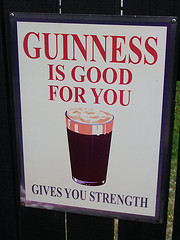
Plausibility rating: 5 out of 10Guinness had stopped using it’s famous slogan in Britain by the 1980s (though it continued in use in Africa and some other countries until the 1990s when – with a nudge and a wink to the belief that it was good for the libido – it was replaced with ‘Guinness: the power’). Whether because of the slogan or not, belief that it was in some way medicinal and – in particular – was a good source of iron has prevailed: a free pint of Guinness after donating blood was only ended in Ireland in 2010. We’ve already seen (Ways to live to 100, number 2) that alcohol in moderation is generally associated with longer life (albeit with some reservations) – but is Guinness any better for you than other alcohol? Well, just possibly. Researchers at the University of Wisconsin found that dogs given Guinness had less blood clotting than those who drank lager – an effect similar to aspirin. It is also surprisingly low in calories compared to most other beers. On the other hand, it’s not a good source of iron: you’d need to drink 15 pints of Guinness (definitely not good for longevity) to get the same amount of iron as there are in two Weetabix. And – sorry Gladys – not many doctors would recommend drinking in pregnancy these days. So, all in all, Guinness is probably good for longevity in moderation – but no more than other alcohol. That’s not much of an advertising slogan though, is it?

photo credit: Old Advertisements via photopin (license)